A Theory of Everything is a set of theories explaining the basic laws of the universe.
Based on the curvature of spacetime discovered by Einstein in the 1910s, the Spacetime Model
extends General Relativity to all components of the universe.
It solves up to 50 enigmas of Modern Physics.
Therefore, the Spacetime Model may be labelled "Theory of Everything".
Moreover, this Theory of Everything is fully compatible with the most recent experimentations.
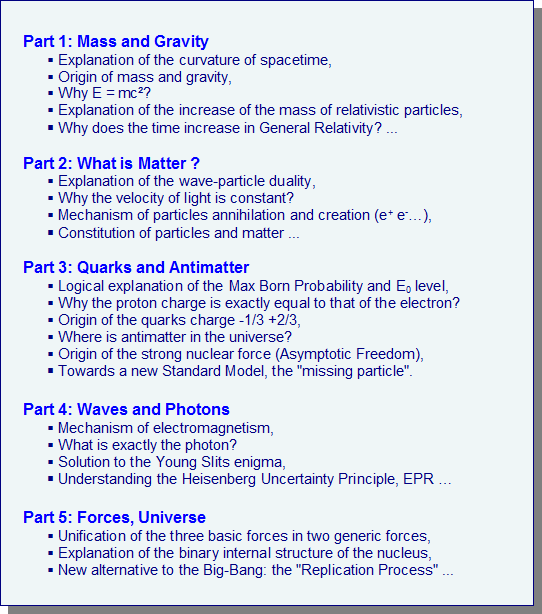
To improve readability, the Spacetime Model has been divided in five parts:
The following sections show three examples of the content of this new Theory of Everything,
the "Spacetime Model".
Example 1
Mass and Gravitation
A Theory of Everything must solve the enigma "What are mass and gravitation?".
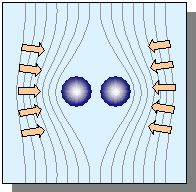
The Spacetime Model demonstrates that the curvature of spacetime is not concave but convex.
The latter exerts a pressure on the surface of massive objects.
So, gravitation would not be an attractive force as we think, but a pressure force
exerted by spacetime on objects that tends to bring them closer to each other.
The former "attractive force" of gravitation gives identical results.
For example, a pressure on one side of a sheet of paper is identical to an attraction on the other side.
Example 2
Where is Antimatter in the Universe?
A credible Theory of Everything must indicate where is located antimatter in the universe
since it is one of the greatest enigma of Modern Physics.
The Spacetime Model gives a logical and rational solution to this enigma.
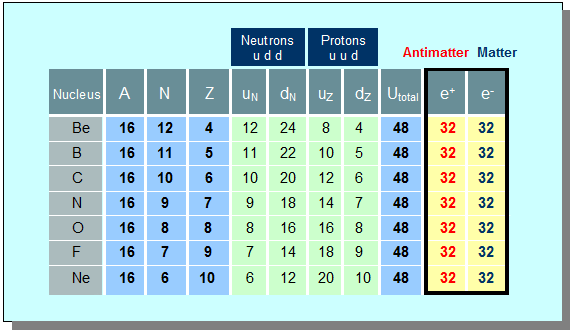
The table below shows seven isobars A = 16 (beryllium, boron, carbon, nitrogen, oxygen, fluorine, neon)
and can be extended to all nuclei.
The last two columns show the number of electrons and positrons in each atom, i.e. 32 here.
The detail of calculus is given in Part 2.
As we see, each atom has exactly the same number of electrons and positrons, which is 2A (A = atomic number).
This means that antimatter is not located in the deep universe as all physicists around the world think,
but ... under our eyes, in quarks.
This rule is successfully applied to the 2930 known nuclei.
The only exception is the Li3 but this nucleus has a particularity that fully explains this exception.
So, the success percentage of this theory is not 99,99% but 100%.
Therefore, we can consider that this part of the Theory of Everything "The Spacetime Model" is not a pure
speculation but reality.
Example 3
What is Matter?
A Theory of Everything must also explain the nature of matter.
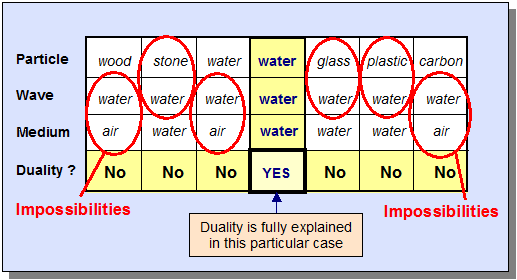
The solution to this enigma lies in the wave-particle duality.
Matter presents the particularity of having a wave and particle behavior.
This phenomenon is known as the wave-particle duality.
Since the 1900s, this enigma has still not been solved.
The Spacetime Model gives a simple solution to this enigma.
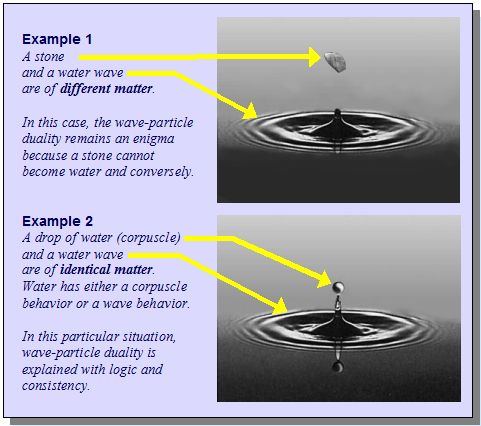
It means that the duality only appears in this particular situation where the particle, the wave, and the medium
have the same constitution
The knowledge of the wave-particle duality mechanism is very important because it leads directly to the
knowledge of matter.
Indeed, "If we find the nature of medium or waves, we will know, by deduction, the nature of particles
(i.e. matter)".
Where to get the
Spacetime Model
The Theory of Everything called "The Spacetime Model" is available on Internet at:
This Theory of Everything, the Spacetime Model, is also available in five
free of charge PDFs of 40-80 pages each, combined in a book of 269 pages.
These documents can be downloaded from any of the above websites.
Thank you for your attention and enjoy reading these websites.
The author, Jacky Jérôme